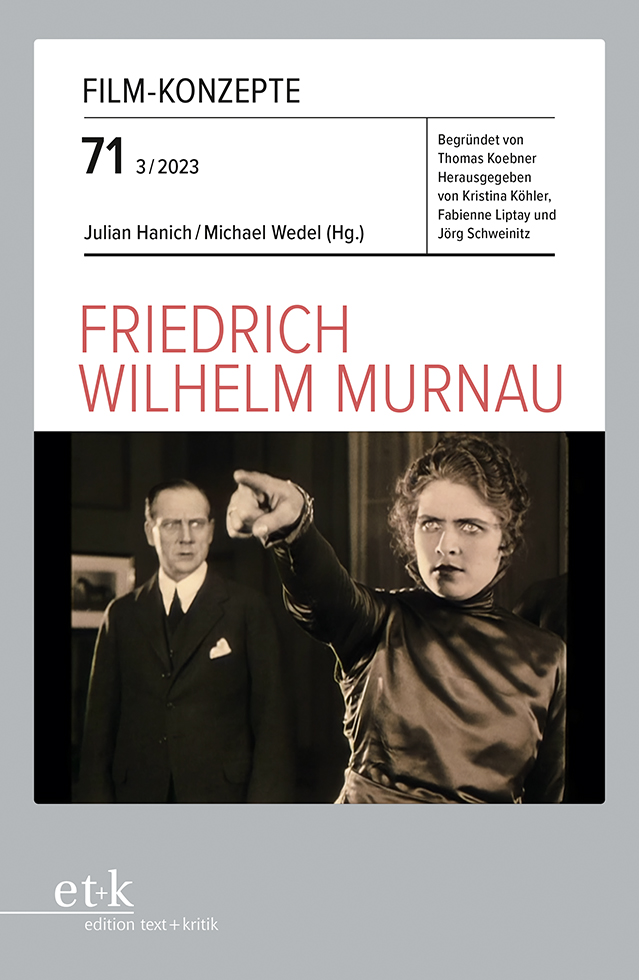





Julian Hanich, Michael Wedel (Hg.)
Publisher: edition text + kritik, München 2024.
Language: Deutsch
107 pages, 14.7 x 0.8 x 22.4 cm
ISBN 978-3-96707-889-3
Friedrich Wilhelm Murnau (1888–1931) is undoubtedly one of the most renowned figures in film history, and his outstanding significance for both German and international cinema is beyond dispute.
Among the directors profoundly influenced by Murnau are Alfred Hitchcock, Jean Renoir, Marcel Carné, Éric Rohmer, Werner Herzog, and Terrence Malick. In contrast to the pronounced modernity of the films of his great Weimar-era counterpart Fritz Lang, scholarly discourse has often portrayed Murnau as a “tragic romantic” or a “melancholic poet” of cinema. This image has largely been shaped through analyses of a limited number of films, most notably Nosferatu (1921/22), Faust (1926), Sunrise (1927), and Tabu (1931).
This volume seeks to question—and where necessary revise—the prevailing image of Murnau and to open his work to new critical approaches. The contributions engage not only with individual films, but also pursue cross-cutting thematic, motivic, and aesthetic explorations across his oeuvre. In doing so, they aim to reveal new constellations and to foreground contexts and perspectives that have thus far received little attention in previous studies on Murnau.
The volume was developed on the basis of the symposium “Friedrich Wilhelm Murnau: Themes – Motifs – Concepts”, which was funded by the ZeM in 2023.